

Aura cleansing is a spiritual way of describing a fresh start: putting down the weight of a difficult conversation, marking the end of work or creating a quiet moment for yourself. Some people understand it literally as clearing an energy field; others use it as a metaphor. Those interpretations should not be presented as established facts about your body.
You do not need to assume that you are contaminated, buy cleansing products or repeat a ritual until you feel perfectly positive. This guide offers a smoke- and fragrance-free personal practice and explains what to consider before using the products commonly associated with aura cleansing.
Quick guide
- Separate meaning from proof: feeling different after a ritual does not establish that an aura has been purified.
- Start without products: an ordinary pause and a practical next step can form your whole ritual.
- Check physical risks: spiritual labels do not make smoke, oils or sprays harmless.
- Keep an endpoint: you do not have to repeat a practice until every uncomfortable feeling disappears.
What are you hoping to clear?
Before choosing a method, make the aim concrete. “My energy feels heavy” might be your preferred description, but ask what is happening alongside it: an unfinished task, an argument, too many messages or a need for time alone. These observations give you something specific to respond to without assigning a supernatural cause.
Noticing someone approach does not, by itself, demonstrate contact between auras. Nor does feeling unsettled prove that another person has transferred harmful energy to you. Leave room for uncertainty rather than turning everyday experiences into a test of spiritual cleanliness.
A five-step, product-free reset
This is an optional editorial reflection exercise, not a treatment or a method for measuring energy. Do it in an ordinary room, on a porch or anywhere comfortable and appropriate. No special setting is required.
- Mark the transition. Close the work notebook, set down your bag or put a non-urgent conversation on pause. Choose one clear signal that this activity has ended for now.
- Describe one event. Use a plain sentence: “The meeting ran late” rather than “Everyone’s negativity is attached to me.” You can retain spiritual language while distinguishing it from what you observed.
- Name what remains. Perhaps you feel disappointed, have a question to ask or need to finish something tomorrow. You do not have to turn that feeling into gratitude or resolve it immediately.
- Choose one response. Write the question down, decide when to return to the task or prepare a simple boundary. Select an action within your control, not a promise that another person will change.
- End the ritual. Put the note away and return to an ordinary activity. If you feel no different, the practice has not revealed a spiritual failure. You may skip it next time.
Fictional example: After an awkward phone call, Marcus wants to “clear the energy” before dinner. He closes his laptop, writes “I felt rushed and did not ask my question,” and decides to request a separate conversation tomorrow. He puts the note away. The ritual gives him an endpoint; it does not establish what the other person intended or remove the need to follow up.
For a broader plan addressing everyday pressures, see our practical guide to managing stress and finding support. A symbolic reset should sit alongside ordinary problem-solving, not replace it.
Smoke, oils, crystals and sprays: different choices, different limits
Sage and incense
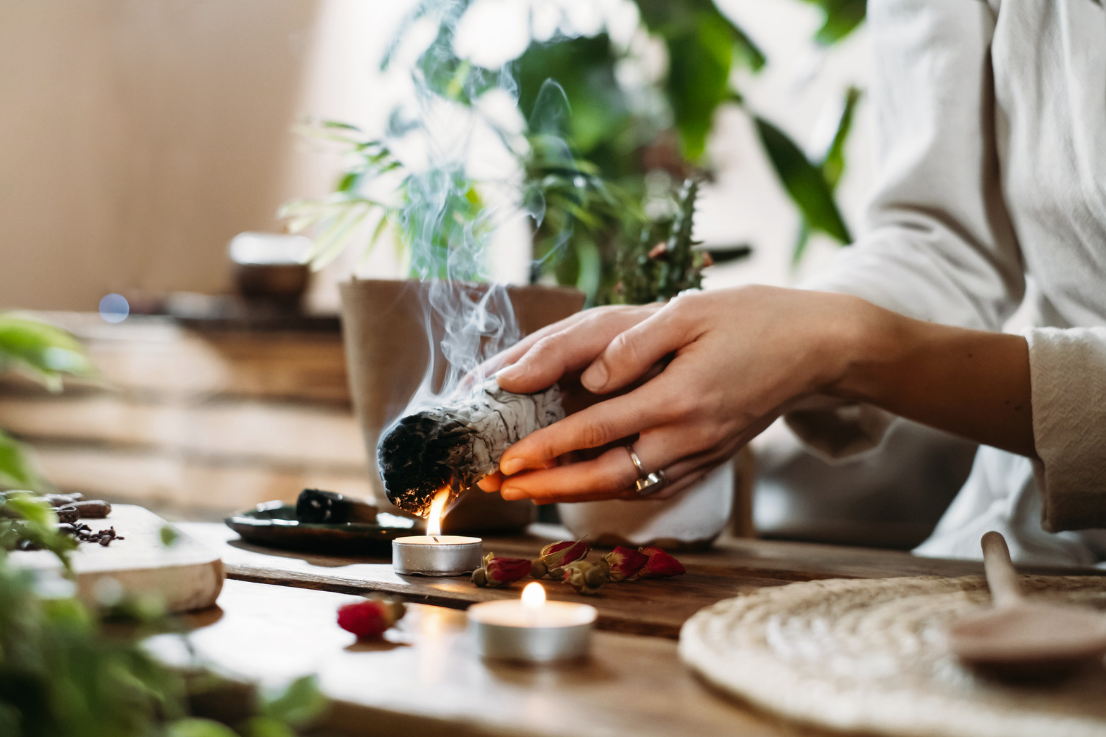
The cover illustrates a smoke-based practice, not a recommendation to burn anything. The U.S. Environmental Protection Agency explains that burning materials produces particulate matter and advises proper ventilation when candles or incense are burned indoors. A cleansing intention does not make smoke an air purifier. The product-free exercise above avoids adding ritual smoke to the room.
Do not treat practices from different communities as interchangeable or assume that a commercial bundle teaches a particular tradition. If cultural or religious participation is your aim, learn from the relevant community rather than a generic shopping list.
Essential oils
Poison Control warns that natural oils can cause skin reactions and some can be poisonous when swallowed or absorbed through the skin. Use products only as labelled; do not swallow oils for aura cleansing. Keep bottles locked away from children and pets. If a skin reaction occurs, stop using the product and gently wash it off.
If someone swallows an essential-oil product, contact a poison centre promptly; in the U.S., call 1-800-222-1222. Elsewhere, use your local poison service. An allergic reaction involving difficulty breathing is a medical emergency: call your local emergency number. These are product-safety concerns, not signs of an energetic release.
Crystals and meaningful objects
A crystal can serve as a chosen reminder, much like a photograph or a familiar ornament. That personal role does not demonstrate purification or protection. You do not need to buy one, and you can choose an object you already own.
Separate spiritual “charging” from physical care. Do not assume that every stone, coating or jewellery setting should be soaked or left in sunlight. Follow the supplier’s care instructions for the specific item; this guide does not recommend adding minerals to drinking water or skin products. Our guide to crystals as reflection prompts explains how to keep symbolism separate from predictions.
Aura sprays
“Aura spray” is a spiritual marketing description, not enough information to judge a formula’s safety or intended use. Check the ingredients, warnings and whether the label specifies room or body use. Do not choose a homemade mixture by intuition or assume that adding water makes every ingredient suitable.
You can omit sprays entirely. A spoken intention, a note or simply putting an object away provides a symbolic ending without spraying a product on yourself, someone else or a shared space.
Keep the practice optional
A ritual should not become a bill you must pay, a threat that something bad will happen if you stop or a way to blame yourself for illness. Be wary of anyone who claims to detect dangerous contamination and then sells repeated removal sessions as the only solution.
If a concern is affecting your health or daily life, seek appropriate professional support rather than relying on cleansing to explain or solve it. You can discuss a spiritual belief without accepting a seller’s diagnosis. You also do not owe anyone participation in a ritual, fragrance exposure or permission to touch you.
Key takeaways
- Aura cleansing can be framed as personal symbolism without purification guarantees.
- A concrete observation and one practical next step give a reset a useful focus.
- Smoke, oils and sprays carry physical considerations regardless of their spiritual label.
- No product, perfect feeling or repeated ritual is required for the optional practice here.
Frequently asked questions
What does aura cleansing mean?
In spiritual language, aura cleansing refers to a ritual intended to clear unwanted energy. You can use the phrase for a personal reset without treating feelings as evidence of contamination or claiming that a measurable field has been purified.
Can I cleanse my aura without smoke or essential oils?
You can choose a completely product-free symbolic ritual: pause, name what happened, decide what needs attention and mark the end of the activity. No smoke, scent, crystal or purchase is necessary for that personal practice.
Do crystals need charging to work as a reminder?
No charging schedule is needed to use an object as a personal reminder. Spiritual charging is a belief-based practice, not a demonstrated maintenance requirement. Follow care instructions for the particular material rather than a universal soaking recipe.
How often should I do an aura-cleansing ritual?
There is no required schedule for the optional reflection described here. Use it only if you find it helpful, and stop if it increases worry or pressure to repeat it. An unfinished ritual does not mean that you are unsafe.