

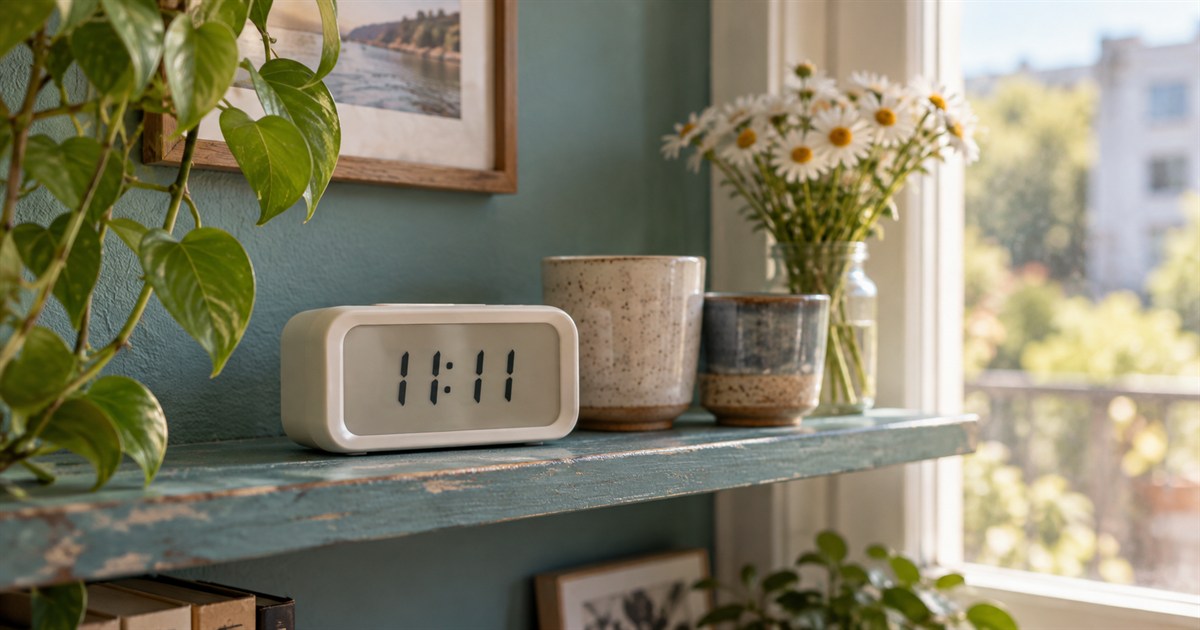
Seeing 11:11 while thinking about someone can feel striking. In angel-number beliefs, repeated sequences are given spiritual meanings. You can find a moment personally meaningful without treating it as proof that someone loves you, that an ex will return or that a relationship is meant to last.
Quick guide
- Symbol, not evidence: a number does not reveal another person’s private thoughts.
- Reflection, not prediction: use a theme to ask a useful question rather than forecast an outcome.
- Behaviour matters: consent, respect and follow-through matter more than a reassuring interpretation.
- No obligation: you do not need to keep searching for signs or pay someone to decode them.
What are angel numbers in a love context?
The term describes number patterns interpreted as messages from angels, the universe or spiritual guidance. In a relationship context, a reader might attach themes such as beginnings, balance or change to a sequence. Those are interpretations within a belief system, not information supplied by your partner.
This guide does not present a universal code, a historical lineage or a scientific method for predicting love. It uses the themes below as optional prompts. A number can remind you to consider your values; it cannot tell you whether another person shares them.
Why a repeated number may feel convincing
The APA Dictionary of Psychology describes confirmation bias as favouring information that supports an existing expectation while overlooking contrary information. Applied to this topic, that offers one possible explanation for why a memorable number seems to confirm a hope. It does not determine the cause of any particular experience or dismiss its personal meaning.
For example, noticing 222 after a friendly message may feel like confirmation of romance. But the message’s actual wording, the person’s stated intentions and how they behave over time are separate evidence. A number on a clock adds no statement of consent or commitment from them.
Number themes as relationship reflection prompts
The pairings here are an editorial reflection exercise, not standardized definitions or forecasts. Choose a question that helps, or skip the number entirely. None of these sequences predicts marriage, a breakup, a reunion, wealth or healing.
| Number and theme | Question to consider |
|---|---|
| 111 / 11:11 Beginning |
What would a healthy next step look like, without assuming someone new is coming? |
| 222 Balance |
Are effort, time and decision-making genuinely shared? |
| 333 Support |
Who can offer a perspective outside this relationship? |
| 444 Foundation |
Which consistent actions show respect and reliability? |
| 555 Change |
What is actually changing, and what choices remain mine? |
| 666 Reflection |
Am I neglecting my needs or avoiding a practical concern? |
| 777 Growth |
What have I learned, without promising myself a reward? |
| 888 Enoughness |
What does a fulfilling relationship mean to me beyond status or spending? |
| 999 Completion |
What can I let go of without needing a prediction or another person’s response? |
Try a four-part reality check
If a number catches your attention, this optional exercise can help separate an experience from the story attached to it. It is a journaling tool, not a clinical assessment.
- Name the observation. “I saw 11:11 on the clock” is different from “The universe confirmed this relationship.”
- Name your hope or worry. Perhaps you want reassurance, miss someone or feel unsure about a recent conversation. You can acknowledge that feeling without treating it as a prediction.
- Identify the relevant facts. What has the other person actually said? Have agreements been respected? Include facts that do not support your preferred outcome.
- Choose a proportionate action. If contact is welcome and safe, ask a clear question. If someone requested distance, respect it. If no action is needed, return to your day.
You do not need to document every number you see. If recording or searching for patterns becomes absorbing or upsetting, put the exercise aside. For broader decision-making, see our guide to intuition and overthinking.
When you are dating or in a relationship
A hopeful interpretation should not replace a discussion about what you both want. Rather than asking whether 444 means the relationship is secure, ask what security would look like in practice: keeping agreements, being able to disagree without intimidation and sharing decisions freely.
The NHS guide to healthy relationships emphasizes respect, support, open conversation and listening. It also encourages boundaries and an outside perspective. These are practical areas to explore whether or not numbers have spiritual meaning for you.
If both people want to reconnect, our relationship reconnection guide offers questions about mutual willingness and next steps. A symbol does not obligate either person to stay, forgive or become more intimate.
After a breakup: a sign is not permission to reconnect
Seeing 111, 555 or 999 does not establish that an ex misses you or that grief is almost over. You can miss someone and still respect the end of a relationship. No-contact requests remain valid regardless of what a sequence means to you.
Fictional example, not a testimonial: Mara notices 11:11 after thinking about her ex. She briefly hopes it means a reunion, then remembers that they asked for no contact. She writes an unsent note and speaks with a friend instead. Her choice does not resolve spiritual beliefs; it respects a clear boundary.
Likewise, visualization or a number ritual cannot supply another person’s consent. If you are single, reflecting on the relationship you want can be a personal exercise, but it cannot guarantee a specific partner or a timeline.
Do not let an interpretation override safety
A reassuring number does not cancel controlling behaviour, threats, humiliation or unwanted contact. You do not need a different number—or a reader’s approval—to take a concern seriously. The NHS relationship guide also links to support for domestic abuse. Seek confidential help if you feel unsafe rather than confronting someone because of a prediction.
Be cautious if someone claims a sequence proves you must buy a reading, remove a curse or act before a spiritual deadline. You can decline. If number-checking or fear about signs is interfering with sleep, daily activities or your ability to make decisions, consider speaking with a qualified mental health professional. This is a reason to seek support, not a diagnosis based on your beliefs.
Key takeaways
- Angel-number meanings are spiritual interpretations, not messages verified to come from a partner.
- A useful prompt leads back to your needs and observable facts.
- Relationships require freely given consent; signs cannot provide it.
- You may enjoy symbolism without predicting outcomes or ignoring boundaries.
Frequently asked questions
Does seeing 11:11 mean someone loves me?
A repeated time cannot establish another person’s feelings. If it feels meaningful, use it as a prompt to reflect, but look to clear communication, mutual interest and consistent behaviour for relationship information.
Do 444 or 777 prove that a relationship is safe or destined?
No. A number sequence cannot verify safety, compatibility or destiny. Threats, pressure and disrespect should not be dismissed because a number has a reassuring spiritual interpretation.
Should I contact an ex because I keep seeing angel numbers?
Not on that basis alone. Consider why contact would be appropriate and respect any request for no contact. Repeated numbers do not override another person’s boundaries or show that they want to reconnect.
Can I enjoy angel numbers without using them to predict the future?
Yes. You can treat them as personal symbols or optional journaling cues. Keep the meaning you give them separate from factual claims, and stop looking for signs if the habit becomes distressing.