

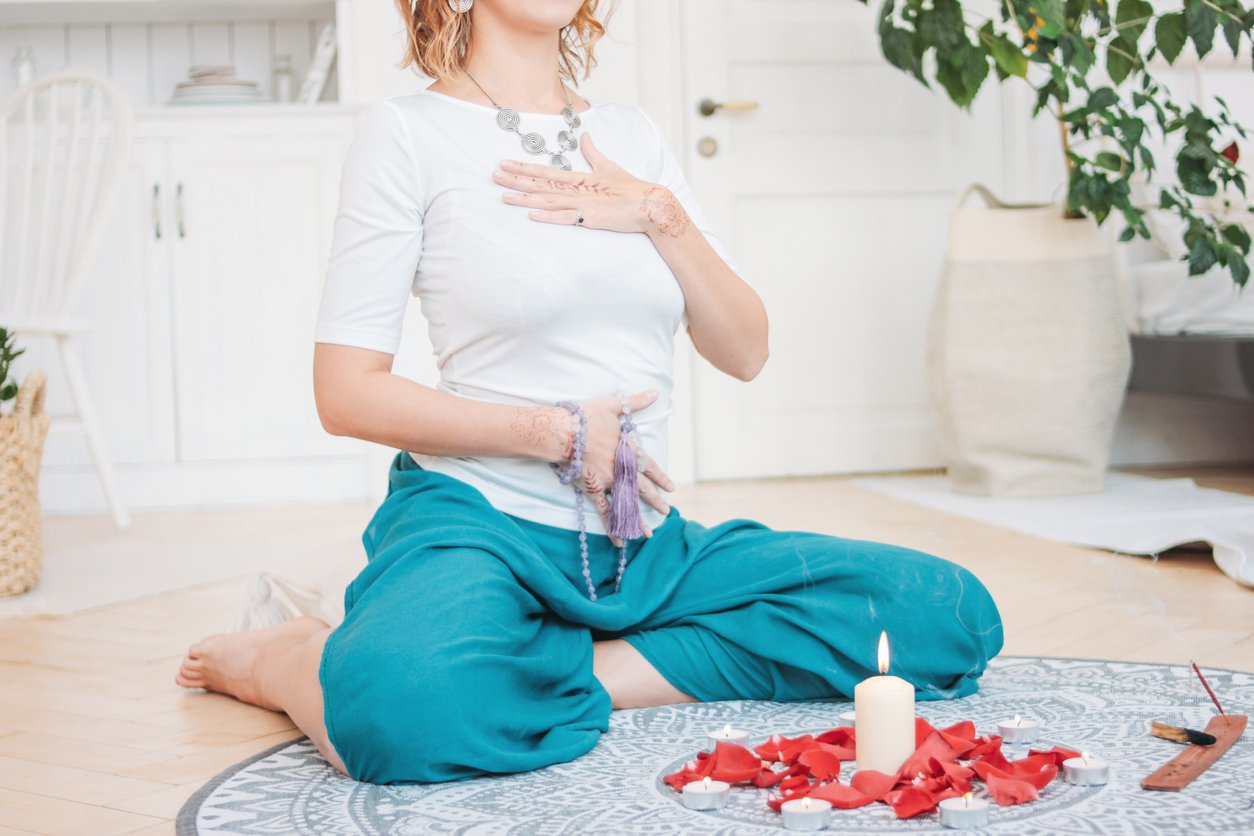
Chakra meditation may appeal if you enjoy spiritual symbolism, a spoken guide or a quiet period of attention. It is optional: you do not need to meditate or “open” an energy centre for your body to function properly.
The useful starting question is not “Which chakra is wrong with me?” but “What kind of session, if any, feels manageable today?” This guide focuses on selecting a practice, adapting its instructions and knowing when to stop.
Quick guide
- Symbolism is not diagnosis: moods, desire and physical symptoms do not identify a defective chakra.
- Choose your format: visualisation is only one option; a neutral sound or visible object may suit you better.
- Keep control: lights, posture, eye position and session length can be adjusted.
- Preserve care: meditation is not a replacement for treatment or an assessment of symptoms.
What a chakra-based session is trying to do
A guide may invite attention to named centres such as root, sacral, solar plexus, heart, throat, third eye and crown, or use related words and images. Treat that as the framework of the particular practice, not a medical map of organs or a test you must pass.
You may find the symbolism meaningful without concluding that it explains an illness. Feeling isolated does not show a blocked crown chakra; not wanting sex does not establish a sacral problem; and difficulty speaking up does not prove something is wrong with an energy centre.
For a separate discussion of observing feelings without turning them into an energy diagnosis, see our chakra-awareness guide.
What meditation research can and cannot tell you
The National Center for Complementary and Integrative Health describes meditation as a range of practices that may use attention to breath, sound, images or words. It notes possible benefits for some conditions, but also limitations in research quality and interpretation. Findings about one studied programme should not be treated as proof that a chakra recording heals energy centres.
NCCIH also notes that adverse experiences, including anxiety and depression, have been reported and that safety research is limited. It advises against replacing conventional care or postponing medical attention, and recommends asking about an instructor’s training. A practice being spiritual, popular or described as gentle does not guarantee it suits everyone.
Four checks before playing a guided session
- Read the description. Check its duration, whether it uses body scanning or visualisation, and whether it includes movement or breathing instructions. Choose a format you actually want, not one promising the strongest effect.
- Check the claims. Be cautious about promised cures, guaranteed psychic development or statements that discomfort proves a blockage is releasing.
- Check the teacher’s scope. Ask about relevant training and how participants can adapt or leave. A spiritual title is not the same as a healthcare qualification.
- Make stopping easy. Keep the pause button accessible. You may leave your eyes open, keep the room lit or decide not to begin.
If a guide asks you to do something uncomfortable, you do not need to obey because the session has started. Avoid a class that pressures you to disclose private experiences or purchase another service to correct a problem the teacher claims to have detected.
Choose one focus, not a complete overhaul
The following are original options for this article, not a traditional chakra sequence or a treatment plan. You can leave the chakra labels out entirely.
- If imagery appeals: imagine a simple, familiar colour without trying to feel energy moving. You can stop visualising and look around whenever you wish.
- If you prefer words: silently use a neutral phrase such as “I can pause.” You do not have to repeat an affirmation that feels untrue.
- If inward attention feels uncomfortable: keep your eyes open and notice an ordinary object in the room. You can also choose a different activity instead of meditating.
For people specifically interested in vocal practice, our chakra-mantra guide discusses sounds and optional chanting separately. You do not need to add chanting to the exercise below.
A short, adaptable session
This is an optional editorial exercise, not a tested clinical programme. A few minutes is enough to try it; there is no minimum time you must complete.
1. Settle in a supported position
Use a chair or another position you already find comfortable. Keep the room lit if you prefer. There is no requirement to sit cross-legged, place your hands over a particular body area or close your eyes.
2. Choose one comfortable focus
Select an image, neutral phrase or visible object from the options above. Keep breathing normally rather than forcing a rhythm or holding your breath. If none of the options appeals, skip the session.
3. Notice without grading yourself
If attention wanders, you can return to your chosen focus or finish. Do not score the session by whether you saw colours, felt warmth, stopped thinking or sensed a spirit. None of those experiences is required.
4. End deliberately
Look around and put the recording away. Choose an ordinary next activity. You do not need to complete all seven chakra labels or perform a closing ritual before you are allowed to stop.
Review comfort, not “energy progress”
Afterward, ask: Was the format manageable? Did I feel free to stop? Would I choose it again? “No” is useful information, not evidence that you resisted healing.
Fictional example: Tomas tries a guided recording that asks him to imagine coloured lights. He finds the instruction frustrating, so he pauses it and looks at a plant beside his chair for a short while. He decides that an ordinary quiet break suits him better. There is no need to explain the preference as a blocked chakra.
When to stop and seek support
Stop if you become distressed, dizzy, confused or feel disconnected in a way that worries you. Do not force yourself to finish or assume that an unpleasant experience is spiritually necessary. Speak with a healthcare professional if symptoms persist, recur or concern you. Seek urgent help for an immediate safety concern.
You can choose rest, an everyday hobby or time with someone you trust instead. Meditation is one possible activity, not an obligation, and declining it does not make you less spiritual.
Key takeaways
- Choose a session by its instructions and your comfort, not by promised energy effects.
- You can adapt, pause or decline a guided practice.
- A nonvisual focus is an option, not a lesser version of meditation.
- Keep spiritual interpretation separate from health assessment and treatment.
Frequently asked questions
Can chakra meditation diagnose a blocked chakra?
A meditation experience does not establish a medical diagnosis or prove that a chakra is blocked. Do not interpret sadness, low desire, discomfort or difficulty concentrating as evidence of an energy defect.
Do I have to visualise colours during chakra meditation?
No. For the optional exercise here, you can use a comfortable sound, a neutral phrase or an object you can see. You do not need to produce an inner image or a special sensation.
Must I finish a guided meditation once I start?
No. You can pause, skip an instruction or end the session. A recording or teacher does not override your comfort, consent or healthcare needs.
Can chakra meditation replace treatment?
No. Do not use meditation to replace conventional care or delay an assessment. Discuss complementary practices with your healthcare professional, especially if you are using them alongside treatment.