

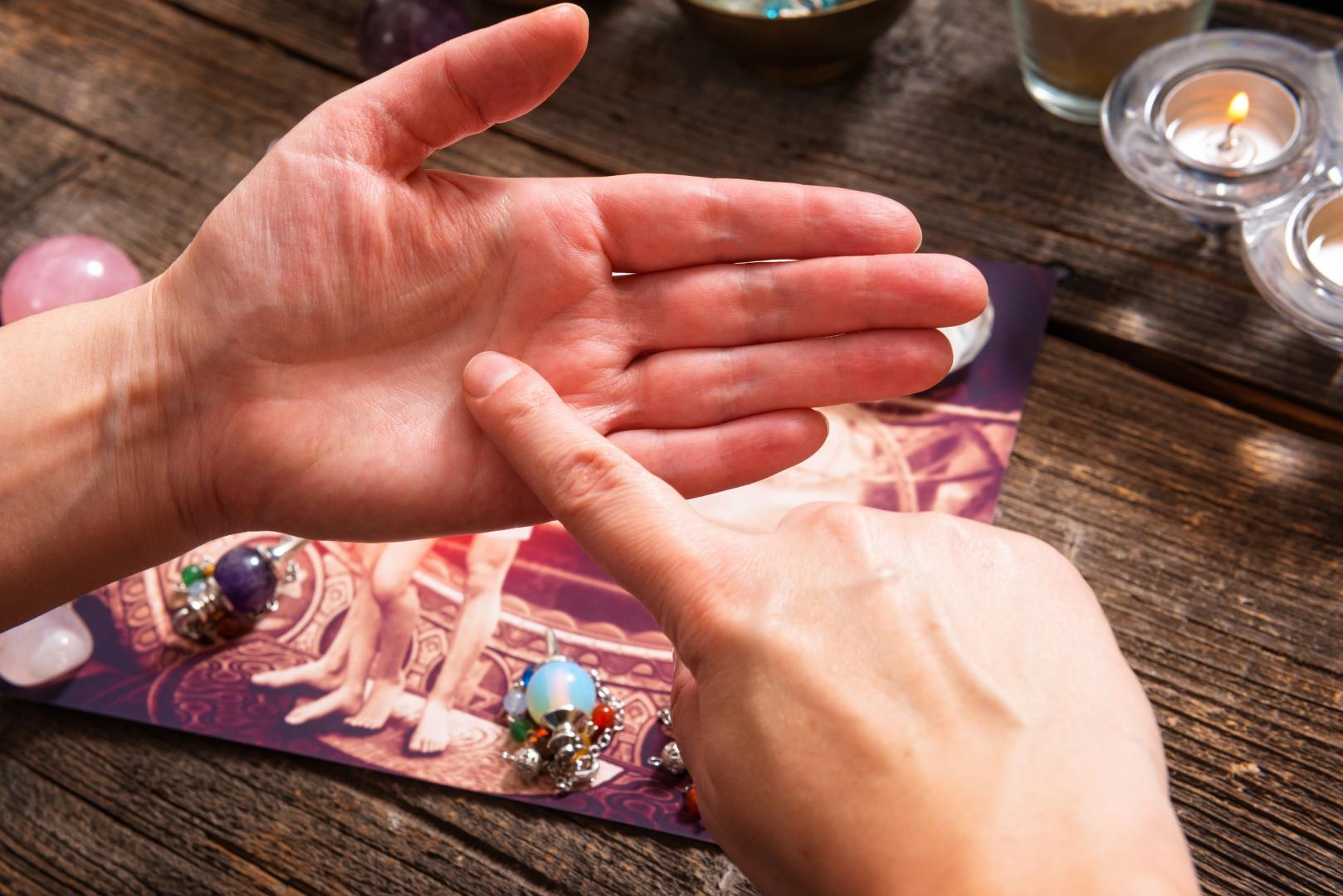
Learning palm reading can begin with something simple: noticing the creases on a hand and learning the names used in a palmistry book. The important distinction is between identifying a feature and claiming that it proves something about a person’s life.
This beginner guide treats palmistry as a symbolic practice, not a method for diagnosing illness, measuring intelligence or forecasting injuries. You can explore its vocabulary without accepting every prediction attached to it.
Quick guide
- Start with observation, not a verdict about someone’s character.
- Learn a few line labels before attempting an elaborate interpretation.
- Keep an uncertain feature labelled “unclear.”
- Ask permission before touching, photographing or discussing another person’s hand.
- Use any chosen symbolism as a question, not as evidence about the future.
A small map of traditional palm lines
Cheiro’s Palmistry for All, published in 1916, provides one historical reference for these labels. Its predictive claims and prejudiced character judgments are not endorsed here.
- Heart line: across the upper palm below the fingers.
- Head line: across the more central part of the palm, below the heart line.
- Life line: curving around the base of the thumb.
- Fate line: a roughly vertical route through the palm toward the area below the middle finger.
These descriptions are a starting map, not a requirement that your hand match a textbook. Do not draw an imagined continuation just to complete the pattern. For a closer look at one feature, our heart-line guide separates symbolic relationship questions from claims about a partner.
What about mounts and hand shapes?
In the same historical vocabulary, the Mount of Mercury is below the little finger, while the Mount of Venus is the padded area at the thumb’s base inside the life line. These are palmistry labels, not measurements of intelligence, sexuality or emotional control.
For your first exercise, simply describe what you see: palm outline, finger proportions and visible creases. Avoid turning “long fingers” into “clever,” or a particular palm shape into “unreliable.” Describing a hand is different from assessing the person who owns it.
If you later study a hand-type classification, write down which author or teaching you are using. Do not combine conflicting descriptions and then present the result as a universal rule.
Try a six-step observation exercise
- Set a modest purpose. Try: “I want to learn three labels.” You do not need a prediction, a special gift or a paid session to begin this exercise.
- Choose a comfortable view. Rest your hand in ordinary light with the palm visible. Do not force fingers apart or stretch a joint. Start with either hand and note which one you chose.
- Find the broad landmarks. Look for the upper crease below the fingers, a more central crease and the curve near the thumb. Compare their positions with the short map above.
- Write a literal observation. Use wording such as “this crease curves,” “two marks seem to meet” or “the lighting makes this difficult to see.” Avoid “this proves I am anxious” or “an accident is coming.”
- Add an optional question. If you enjoy symbolism, choose a question yourself: “Where would I like more flexibility?” Make clear that the question is your reflection, not a message demonstrated by the crease.
- Finish with an ordinary choice. Write down one action that makes sense independently of the reading, or finish without an action. There is no need to keep checking until an interpretation feels certain.
You may compare your other hand as another observation. Do not treat a difference between hands as proof of a hidden personality or a changed destiny.
Keep three kinds of statement separate
- Observation: “I can see a curved crease near the thumb.”
- Chosen symbolism: “I would like to use a curve as a prompt to think about adaptability.”
- Unsupported conclusion: “That curve proves you will recover from an illness.”
The first describes what you notice. The second explains an optional meaning you are choosing. The third makes a consequential claim the exercise cannot establish. A confident voice or a detailed story does not close that gap.
A fictional example: learning without predicting
Elena wants to try palmistry with her friend Marcus. She explains that she is learning labels and is not offering a health or future reading. He agrees to show his palm but declines a photograph, so she makes no image.
Elena identifies a curved crease near the thumb and cannot confidently identify a vertical line. She records “unclear” instead of saying Marcus lacks purpose. He chooses to discuss a project he would like to restart. Together they identify a practical first step: finding his old notes. The choice comes from the conversation, not from proof in his palm.
Boundaries for reading another person’s hand
Agree on the activity before beginning. Someone can decline touch, keep a topic private, reject an interpretation or stop without explaining why. Do not use a hand reading to pressure them into discussing trauma, relationships or medical history.
Keep photographs and notes private unless the person has specifically agreed to sharing. Do not upload a friend’s hand image to an app or public group simply because they agreed to practise with you.
A crease should not become an accusation of dishonesty, a diagnosis of depression or a warning that someone must buy a remedy. For health concerns, use appropriate professional assessment rather than this exercise. For decisions involving another person, rely on what they actually communicate and do.
If you want to take a broader question to a reader, our guide to asking better psychic-reading questions offers ways to focus on your choices without demanding certainty about someone else.
Key takeaways
- Learn the traditional names while keeping their claimed meanings separate from fact.
- Practise clear description and allow uncertainty.
- Do not infer lifespan, mental health, intelligence or moral character from palm features.
- Respect consent and privacy, and let any practical next step stand on its own merits.
Frequently asked questions
Which hand should a beginner use for palm reading?
For the observation exercise here, begin with whichever hand is comfortable to see, then compare the other if you wish. Record which hand you used. This is a practical starting point, not a rule that one hand reveals your future.
Does a short life line mean a short life?
Do not interpret the length of a palm line as a lifespan forecast. This guide uses life line as a traditional label for a crease near the thumb, not as a measure of health or remaining years.
What if I cannot identify every line?
Write “unclear” and leave it there. You do not need to force your hand to match a diagram or assign a meaning to every crease. An observation exercise can remain incomplete.
Can I practise palm reading with a friend?
Yes, if they freely agree to an optional symbolic exercise. Ask before touching or photographing their hand, avoid health and character judgments, and stop whenever they want. Do not present the exercise as a verified prediction.