


Email gives you time to compose a question and read a response later. Live chat gives you a real-time conversation in which you can ask for clarification. The better choice depends on your pace, schedule and the actual terms of the service.
Compare the whole purchase: included questions, delivery or session length, follow-up costs, transcript access and privacy. Neither format makes a reader's predictions more reliable simply because the conversation happens in writing.
Email versus live chat: the practical comparison
| Factor | Live chat | |
|---|---|---|
| Pace | Compose and read in your own time | Exchange messages during a session |
| Clarification | May require another message or paid follow-up | Usually possible during the conversation |
| Scheduling | Delivery window rather than a shared appointment | Reader availability and session time matter |
| Pricing | Often a defined question or package | Often timed; check when billing starts and stops |
| Written record | Email, attachment or account inbox | Transcript access and retention vary |
| Best fit | You want time to reflect | You prefer a back-and-forth exchange |
Scroll sideways to see the full table.
Understanding Email Readings
An email service often asks you to submit one or more questions through an order form or message. The reader writes out a written response with a standard delivery time period. Some services will send an attachment, and others put the answer in an account inbox instead of a regular email.
See what the package actually includes. The price might cover one question, many questions, a specific response length, or general reading. These arrangements aren’t exchangeable. A long response might spend more space on general observations without addressing the question you asked.
Email allows you to have time to edit your question and to read the answers when you’re ready. This can be good for people who want reflection before responding, and it can also leave ambiguity unresolved if the follow-up is limited or separately charged.
Before ordering a reading, look at the delivery window, where the responses will appear, and what happens if they don’t arrive. Don’t just think that a reader’s personal email address gives a certain level of security or the right to ongoing correspondence.
Understanding Live Chat
Live chat gives you the chance to talk with a psychic reader through messages while the reading is happening. If the reader says something you do not understand, you can ask what they mean right away. You can also correct a misunderstanding before the reading moves in the wrong direction. That back-and-forth can be especially helpful when your question is difficult to explain in one long message.
Live chat can sometimes feel rushed. You might feel like you need to type quickly, answer every question immediately, or keep the conversation going because the clock is running. If you are paying by the minute, even the time spent typing or waiting for the reader to respond could affect what you pay, depending on how that particular service handles billing.
Before you start, find out when the timer starts, whether you are still being charged while waiting for a response, and exactly how you end the chat. Some platforms might show you a countdown or let you set a spending limit but make sure you understand what those features actually do. Do not assume that simply closing the browser or leaving the page automatically stops the charges.
You should also feel comfortable saying things like, “Can you explain what you mean?” or “I would rather not share that.” You should be able to end the reading when you are ready too. Having a live conversation with a reader does not mean that you have to give up your boundaries.
Email or Live Chat: visual guide
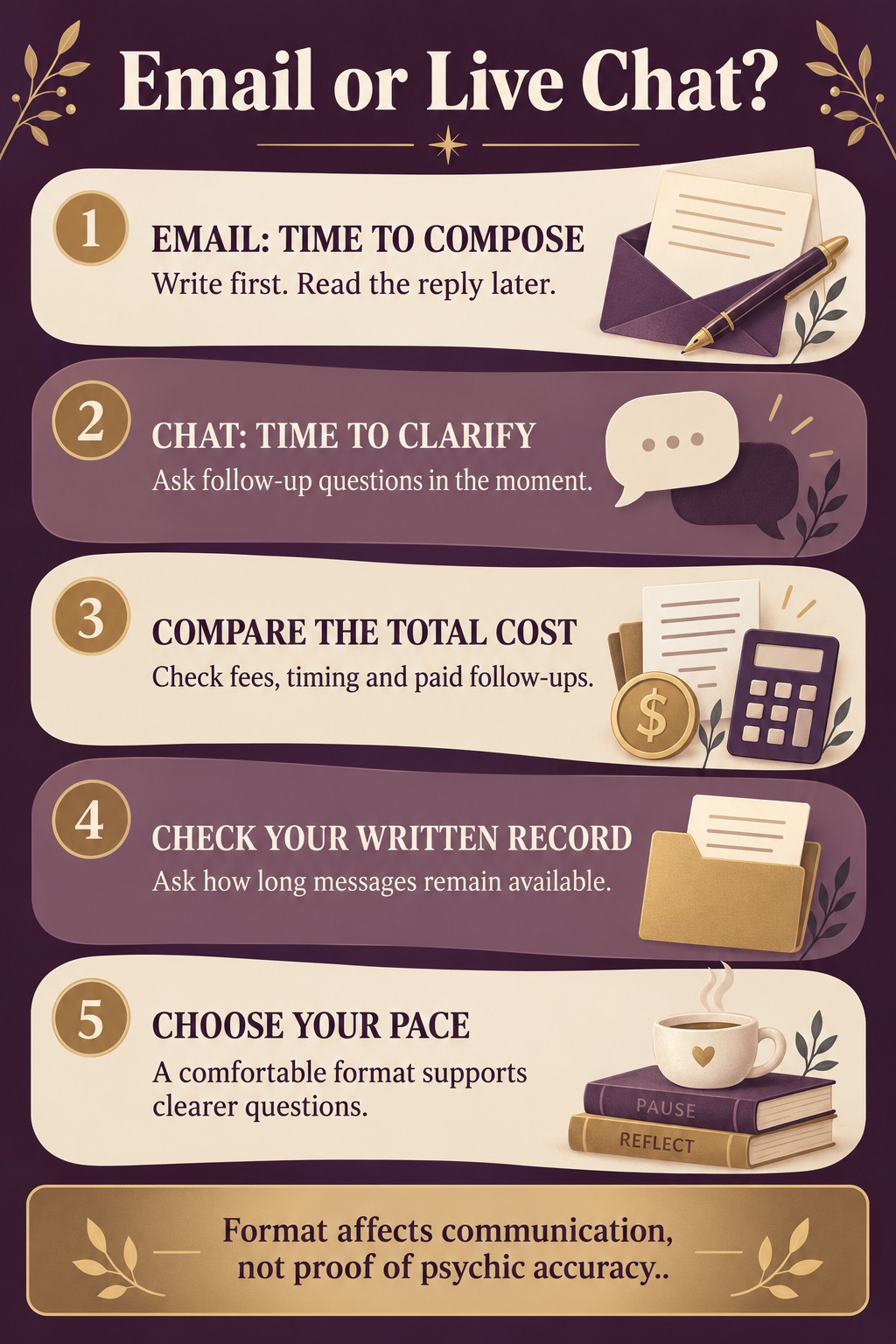
Read the infographic as text
- EMAIL: TIME TO COMPOSE: Write first. Read the reply later.
- CHAT: TIME TO CLARIFY: Ask follow-up questions in the moment.
- COMPARE THE TOTAL COST: Check fees, timing and paid follow-ups.
- CHECK YOUR WRITTEN RECORD: Ask how long messages remain available.
- CHOOSE YOUR PACE: A comfortable format supports clearer questions.
Compare the Formats Using the Same Questions
One of the biggest benefits of an email reading is having time. You can think about your question before you send it and take your time reading the answer when it arrives. The downside is that if something is confusing, you might have to wait for another response or pay for a follow-up, depending on what your package includes.
With live chat, you get the benefit of being able to respond and ask questions right away. At the same time, you might have less time to think about what the reader is saying before you answer.
Both formats can give you something in writing, but do not automatically assume that you will always have access to it. An email might stay in your inbox, while a response sent through a psychic platform could disappear after a certain amount of time. Chat transcripts might be available to download, saved only in your account, or removed after a certain period. If keeping a copy matters to you, check before you book.
Price is another area where you want to compare the actual services instead of making assumptions. An email reading is not always going to be cheaper, and a live chat is not automatically going to give you more information. Look at what is included, how the service is priced, and what you are likely to spend from beginning to end.
It is also worth finding out who is actually giving you the reading. Is it the psychic reader whose profile you picked, a team of readers, automated software, or some combination of these? The fact that you are communicating through email, or live chat does not answer that question.
Match the Format to How You Process Information
Think about how you normally communicate when something is important to you. Do you like having time to think, go back over your words, and make sure you are saying exactly what you mean? Or do you find it easier to explain yourself through a quick back-and-forth conversation? That can give you a good starting point when deciding between email and live chat.
Email might work better if you like to read slowly, want time to think about the response, need to translate part of the reading, or have a schedule that makes setting aside time for a live reading difficult. Live chat might be a better fit if you prefer shorter conversations and find it easier to explain yourself a little at a time.
Accessibility matters too. If you use assistive technology or need certain features to comfortably read and respond, check what the platform offers before paying. You might want to know whether you can enlarge the text, whether the website works with the technology you use, and if the way the reader sends their response will work for you. Just because a reading is done through text does not automatically mean that it will be accessible for everyone.
And remember that you do not have to pick either one. If writing about something personal feels uncomfortable or you think the pressure of a live conversation would make you more anxious, it is completely okay to wait. A psychic reading is optional, and you can always come back to the idea when the timing and format feel better for you.
Knowing the Total Costs
If you picked an email package priced at 35 units of currency for one question, for example, and it has a separately priced follow-up, then look at it with a live chat that charges 3 units per minute. 15 minutes would cost you 45 units before other fees were added. These are math examples and not the current market rates.
This comparison changes if the email needs more purchases to get past the start of the reading, or if the chat answers your questions in fewer minutes than you expect. This is why the included service matters just as much as the price.
The United States Postal Inspection Service's psychic-scam guidance recommends understanding total costs and hidden or continuing fees. Use that principle to check currency, tax, renewal, deposits, and any automatic top-up arrangement relevant to the offer.
Always set a maximum amount you want to spend before you start a reading. A reading should fit within your spending budget. Don’t raise the limit because you’re emotionally intense or because the next message might be important to your future.
Asking About Clarification
For an email, read the difference between an unclear answer and a request for a new reading. A provider might define these things differently. Ask if you can ask for a clarification, how long you have to do so, and whether there’s an additional charge for it.
For a chat reading, write down a short clarification sentence that you can use without giving personal details. You might ask something like, “When you say change, are you talking about an interpretation or predicting a specific event?” This helps you know whether the claim is a claim, rather than trying to fill in the meaning for yourself.
Always be cautious when a request for clarity needs more paid services. You should be able to understand the meaning and the limits of what you purchase. A response that is vague while encouraging more spending might not meet your needs.
It’s also important for the reader to acknowledge uncertainty. If they can’t establish it, they should say so. Giving more information and inventing an answer because the customer expects one isn’t the right path. Clarity needs to have the option to recognize what a service can’t tell you.
Protecting Your Information
Written readings can include names, relationship histories, health concerns, work details, and other material. Don’t share anything unnecessary with the service. You can talk about a situation without giving another person’s full name, employer, address, or private messages.
The FTC's guide on how websites and apps collect information explains that online services may use several forms of tracking. A private conversation with a reader does not mean the surrounding platform collects no data.
Read the privacy policy for access, sharing, retention, and deletion practices. Ask if the staff can look at the transcripts and if messages are used with automated tools. Getting the right answers is more useful than broad language about respecting your energy or your confidentiality.
Use an account and device that you can control. Think about notification previews, shared inboxes, browser history, and saved attachments. These access routes can matter as much as picking between email and live chat.
Keep a Written Record Without Constantly Checking It
Having a copy of your reading can be helpful, especially with an email or chat reading. It gives you a way to go back and see exactly what the reader said instead of trying to remember everything later. A transcript can also be useful if you ever have a question about what you paid for or what was supposed to be included. If the psychic platform lets you save or download your reading, keep it somewhere private and be careful about sharing it when other people’s personal information is mentioned.
The downside is that having everything in writing can make it tempting to read the same messages over and over again. You might start looking for hidden meanings in certain words or wondering if every little thing that happens is connected to something the reader predicted. After a while, that can create more confusion instead of giving you clarity.
It can help to give yourself a reason for looking back at the reading. Maybe you want to remind yourself of the main question you asked, write down something useful that stood out, or see what was left uncertain. You do not have to compare everything happening in your life to every sentence the reader gave you.
If you notice that reading the transcript is making you feel more worried or stressed instead of helping, give yourself permission to put it away and return to your ordinary routines.
Preparing Questions
Start with a situation you could talk about, and a question focused on your own choices. You might ask what you should reflect on before you discuss your needs with your partner, because this is something you can take action on instead of demanding private thoughts or exact dates.
If using email, give enough context to make the question understandable to the reader, then remove any identifying details that aren’t necessary. Put the main question at the beginning, and don’t hide five unrelated questions in a long story when the package only includes one question.
For live chat, keep the same questions close so that the conversation doesn’t turn into another purchase about an unrelated concern. You can say what you mean without turning each new question into a separate problem to solve.
A good way to prepare is to write down what would count as a good service response. It might be a clear interpretation of one question that is delivered within an agreed time period. It shouldn’t require the reader to guarantee an outcome that can’t be promised.
Two Fictional Examples of Finding the Right Format
Nadia works different shifts and has been thinking about making a career change. Since her schedule can be unpredictable, she decides that an email reading fits her better than trying to schedule a live reading. She can write out her question when she has some quiet time and read the response later when she is rested and has time to really think about it. Before paying, she also checks what is included and makes sure she can ask one follow-up question if she needs clarification.
The reading might give Nadia something new to think about, but she still looks at things like available jobs, her finances, and what she actually wants before making any major career decisions. For her, the email reading is simply another way to reflect on the situation. The slower pace also works well with her schedule and gives her time to think about what the reader says.
Ben is a little different. He likes quick conversations and wants some insight into a strange dream that has been bothering him. He decides to try a short chat reading and sets a spending limit before he starts. When the reader uses a term, he does not understand, Ben asks what it means in simple language instead of ending the chat confused and feeling like he needs to pay for another reading just to understand the first one.
Neither Nadia nor Ben picked the “better” type of psychic reading. They simply picked the format that worked best for what they wanted, how they like to communicate, and how much time and money they were comfortable spending. The right format can be different for everyone, which is why it helps to think about those things before the reading begins.
Readings Aren’t Emergency Services
Email or live chat is not an emergency service, a medical diagnosis, or a substitute for legal or financial advice. A quick reply shouldn’t be confused with that kind of professional help.
If the question involves immediate safety concerns or urgent health situations, use the right professional or an emergency route. You don’t have to wait for a reading to confirm that you’re allowed to get the help you need.
A reading also can’t guarantee or establish another person’s consent, prove infidelity, or determine a person’s private intentions. Look at the claims about people who aren’t there with caution, especially if they encourage you to confront them or to have unwanted contact.
Spiritual reflection should work with practical support. Having a useful boundary means that you give each task the responsibility to do what it’s supposed to do, instead of just asking a reading to carry everything about a hard situation or decision.
Final Thoughts: Picking a Reading
Before you buy anything, review the offer as you would any other online service. The FTC's online-shopping guidance emphasizes checking sellers, terms, and payment information. Apply those habits even when the subject of the purchase feels personal or spiritual.
Agree on the delivery window, the included questions and how follow-up requests are resolved. Clear endpoints help you understand what the purchase covers and when an additional charge would apply.
After the reading, look at one useful reflection or an ordinary action you can take. Write down your priorities and ask someone a direct question or decide that the reading didn’t do anything helpful at all. All of these are possible outcomes.
Email gives a place to compose and reflect on your questions. Live chats offer immediate conversation. Pick the format whose pace, turns, and privacy arrangements fit your needs while keeping your judgment and spending limits as boundaries.
If you are comparing additional formats, our guide to phone, chat, email and video readings covers their practical differences.
For the next step, explore writing email reading questions, email delivery and support guide.
Frequently asked questions
1. What is the main difference between email and live chat readings?
Email is generally asynchronous: you send a question and receive a response later. Live chat involves an exchange of messages during a session. Exact delivery and billing arrangements depend on the provider.
2. Which format is more accurate?
The format itself does not establish psychic accuracy. Compare communication style, clarity and service terms rather than assuming a slower or faster response proves more reliable predictions.
3. Is email always cheaper?
No. Compare the package price, number of questions and follow-up charges with the expected total for chat. A low starting price may not describe the full purchase.
4. When does a chat timer start?
That depends on the platform. Ask whether billing includes typing or waiting, how the timer is displayed and which action actually stops charges before you begin.
5. Can I ask follow-up questions after an email reading?
Only if the service includes or offers them. Confirm what counts as clarification, how long you have to ask and whether a new payment is required.
6. Will I receive a chat transcript?
Some platforms provide one, but access and retention vary. Ask whether it can be downloaded and how long it remains in your account if keeping a record matters to you.
7. Can email readings suit an unpredictable schedule?
Yes, because you may not need a shared appointment. Check the delivery window and whether the response arrives by email, attachment or a platform inbox.
8. Which format suits someone who types slowly?
Email may reduce timer pressure, but the best fit depends on the service. Check chat pacing and accessibility features before paying if a live exchange interests you.
9. Is written communication automatically accessible?
No. Check text enlargement, screen-reader compatibility, attachment format and the way messages are presented. A text service can still create barriers for some readers.
10. What information should I include in a question?
Give enough context to explain your own concern, but omit unnecessary identifying details about you or others. Put the main question first and stay within the package's scope.
11. Can a reader tell me what another person secretly thinks?
A reading cannot establish another person's private intentions or consent. Focus on your choices and use direct communication or reliable information for factual questions.
12. How should I set a budget for live chat?
Decide your maximum total beforehand, check the rate and fees, and understand how to end the session. Do not rely on closing a browser tab to stop billing.
13. Are email readings private?
Privacy depends on the provider, platform and your device or inbox. Check access, retention, sharing and deletion policies; avoid sharing sensitive details that the reading does not need.
14. What should I do if the response is unclear?
Ask for a plain-language explanation within the agreed terms. A service should explain the meaning and limits of what was purchased without using vagueness to pressure you into more spending.
15. Can either format handle an emergency?
No. Psychic readings are not emergency services or substitutes for qualified medical, legal or financial help. Use the appropriate support route when a situation requires it.